The roof rat vs Norway rat Florida question comes up in nearly every attic inspection we perform. Say the word “rat” and most people picture a single animal, but the rat in a Florida attic and the rat in a northern basement are usually two entirely different species. The roof rat (Rattus rattus) and the Norway rat (Rattus norvegicus) can look alike at a glance, yet they differ in size, tail length, ears, behavior, and where they choose to nest — and those differences change how you find them, how you keep them out, and how you get rid of them for good. Here is how to tell which one you are dealing with.
The Two Contenders: A Quick Introduction
The species behind the overwhelming majority of Florida’s rodent calls is the roof rat, scientific name Rattus rattus. It goes by several other names too: black rat, ship rat, citrus rat, palm rat. All of those names point at the same animal, and most of them describe exactly where you will find it. According to UF/IFAS Entomology and Nematology, roof rats are the dominant commensal rodent across Florida’s coastal, urban, and suburban areas.
The other species most people picture when they hear “rat,” the Norway rat (Rattus norvegicus), is genuinely uncommon here. Norway rats burrow at ground level, nest in basements and sewer systems, and thrive in the kind of northern, older urban infrastructure that simply does not describe most of Florida. If you are dealing with a rat problem anywhere in this state, the odds are heavily in favor of a roof rat — but knowing exactly how the two differ is what lets you confirm it.
Roof Rat vs Norway Rat Florida: Size and Build Compared
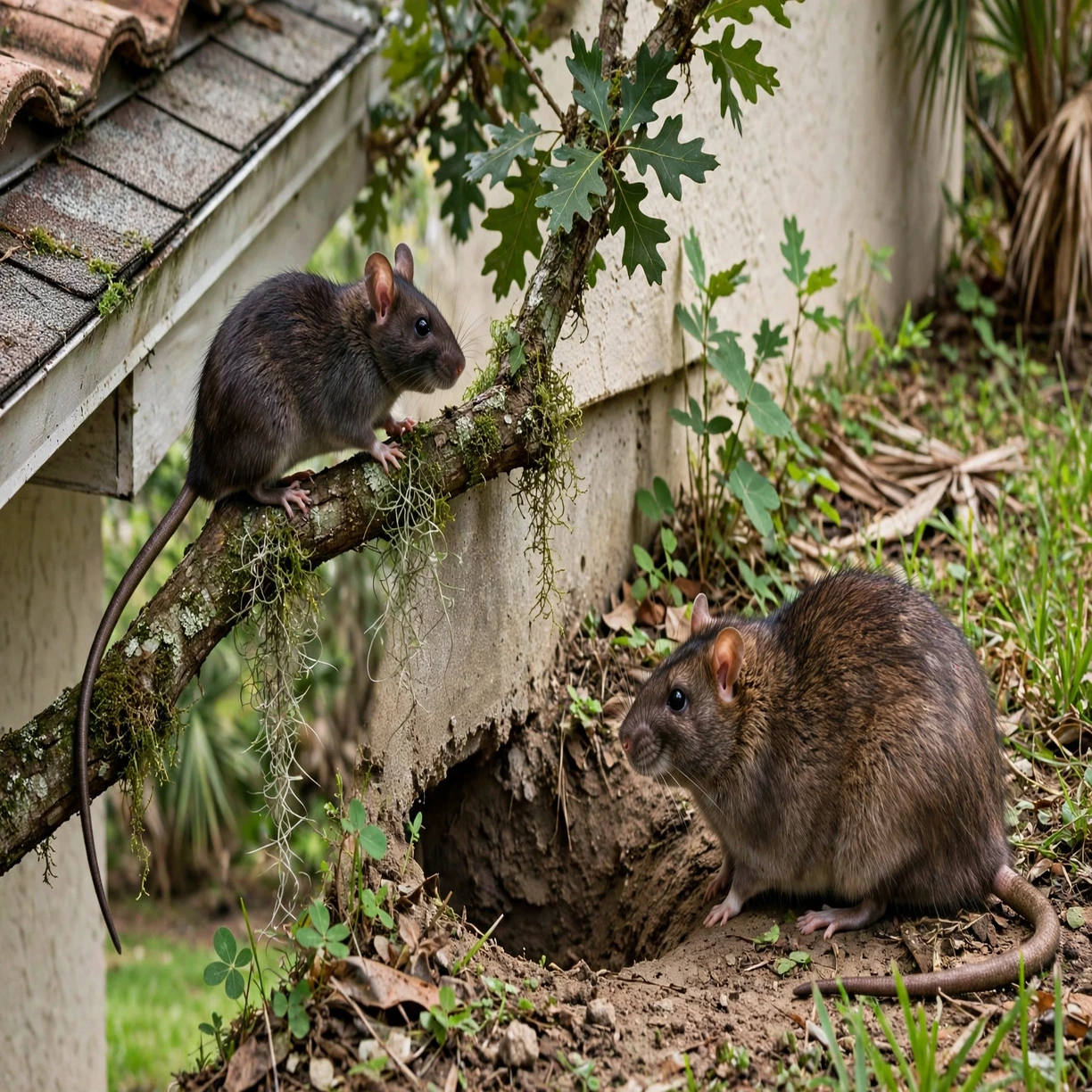
Side by side, the size difference is noticeable once you know what to look for. In any roof rat vs Norway rat Florida comparison, adult roof rats run about 6 to 8 inches long in the body and weigh in the range of 4 to 10 ounces, with a noticeably lighter, more slender build. Norway rats are the heavyweights: roughly 7 to 10 inches in body length and 11 to 18 ounces, with a thick, stocky frame that looks built for digging rather than climbing.

Wild rats foraging — size and build are key field marks in the roof rat vs Norway rat Florida identification.
The muzzle tells the same story. A roof rat has a pointed muzzle and large ears relative to its head, giving it a sharp, alert look. A Norway rat has a blunt, rounded muzzle with small, close-set ears. If the animal you are looking at seems sleek and sharp-featured, you are likely looking at a roof rat; if it looks bulky and blunt-faced, think Norway rat.
Roof Rat vs Norway Rat Florida: Tail, Ears, and Feet
When you only get a quick look, the tail is the single fastest field mark for the roof rat vs Norway rat Florida identification. A roof rat’s tail is usually longer than its body, sometimes reaching 8 or more inches on its own, for a total length approaching 16 inches. A Norway rat’s tail is shorter than its body and looks thick and stubby by comparison.
The feet confirm the verdict. A roof rat’s feet have long, slender toes built specifically for gripping and climbing — an animal equipped to travel along power lines, scale palm trunks, and walk fences. A Norway rat’s feet are stockier and built for digging, matching a lifestyle spent burrowing at ground level rather than navigating the canopy.
Roof Rat vs Norway Rat Florida: Behavior and Nesting
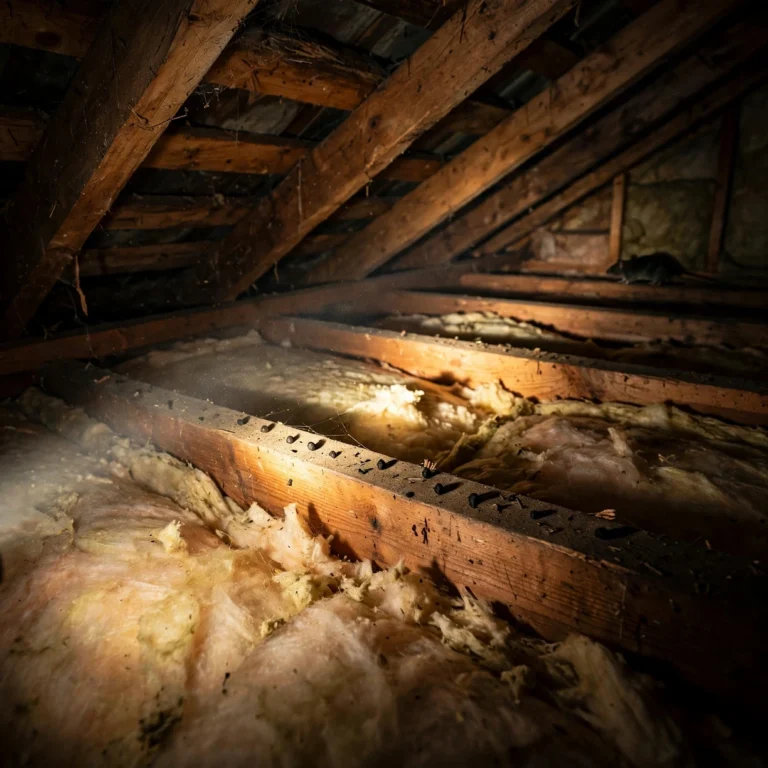
Behavior is where the two species truly part ways. Roof rats are climbers: they travel along power lines and fences, and UF/IFAS reports they can jump roughly 3 feet vertically and more than 4 feet horizontally, so a tree branch does not need to touch a roofline to serve as a bridge. Once on a structure, they look for elevated entry points — roofline gaps, chimney openings, soffit seams, and vent covers — and nest above floor level in attic insulation, soffit voids, and wall cavities. Our rat removal process starts at the roofline specifically because of this climbing behavior, not as an afterthought.
Norway rats do the opposite. They burrow at ground level, nest in basements, crawlspaces, and sewer systems, and enter structures through foundation gaps, ground-level vents, and openings around utility lines near the soil. In the roof rat vs Norway rat Florida picture, Norway rats are rare here, but where they do show up — near canals, older foundations, and ground-level harborages — the inspection starts at the ground, not the roof.
Signs: Which Rat Left These Clues?
The evidence each species leaves behind points in opposite directions — literally. Here is how the roof rat vs Norway rat Florida signs compare:
- Droppings: roof rat droppings are banana shaped and roughly half an inch long, usually found along attic joists or near stored items; Norway rat droppings are capsule shaped with blunt ends and closer to three-quarters of an inch, found at ground level.
- Gnaw and rub marks: roof rats leave them around eaves, roof edges, and soffit seams, plus greasy rub marks along rafters and beams; Norway rats gnaw low on doors and foundation vents, leaving worn runways along walls at floor level.
- Sound and timing: scratching or running sounds overhead at night point to roof rats, which are nocturnal; Norway rats are nocturnal too, but their activity stays at ground level. Daytime attic noise usually means squirrels, not rats.
- Burrows vs canopy: Norway rats dig visible burrow holes near foundations, embankments, and debris piles; roof rats dig no burrows but show activity in palm trees and dense canopy near the house.
Because roof rats nest above ground, their signs typically show up in the attic and roofline long before anything is noticed at floor level — which is part of why an infestation can be well established by the time a homeowner first notices it.
Why Roof Rat Behavior Changes the Approach Across Florida
Because roof rats climb rather than burrow, the entry points and prevention strategy look different depending on what kind of property and landscaping you are dealing with, even within the same general region. A home under mature oak canopy in an older neighborhood faces a different pattern than a newer property with sparse landscaping, and a waterfront home with dense tropical growth faces a different pattern again.
We see this play out across our service area in ways that are genuinely specific to each community. In Boca Raton, roof rats move differently through the century old canopy streets of neighborhoods like Old Floresta than they do through the newer, HOA maintained landscaping of the West Boca country club communities. In Delray Beach, the same split shows up between the historic barrel tile homes near Del Ida Park and the newer construction further west. Along the water in Ocean Ridge, roof rats move off the mangrove preserve directly onto rooflines, while in Lantana, the dense, irrigated landscaping on Hypoluxo Island creates a similar bridge for a very different kind of property. Even in a small town like Hypoluxo, the native scrub habitat inside town limits keeps a steady, low level pressure going that has nothing to do with tree cover at all. In Lake Worth Beach, the density of the historic districts means a roofline entry point on one home is often only a few feet from the next one over.
The species is the same everywhere. The path it takes to get onto your roof depends entirely on what is actually growing, built, and maintained around your specific property.
Why It Matters: Different Rat, Different Approach
Knowing which species you are dealing with changes the entire strategy — and getting the roof rat vs Norway rat Florida identification right is the first step. Because a roof rat’s entry points are almost always at or above the roofline, trapping alone rarely solves the problem long term — the branch still touching the eave or the soffit gap that let them in has to be addressed, or new activity returns within a season. Our exclusion work focuses on sealing roofline gaps with materials that hold up against a determined climber and Florida’s humid, coastal conditions.
A Norway rat problem, by contrast, is solved at ground level: sealing foundation gaps, removing ground-level harborages, and addressing burrows directly. Treating a roof rat problem with a ground-level approach — or vice versa — is why so many do-it-yourself efforts fail. Either species can contaminate food surfaces and insulation through droppings and urine, so an unidentified infestation is worth confirming rather than ignoring. If the signs point to a roof rat, our guide to roof rat removal in Boynton Beach walks through the full identification and removal process for this species.